
- Home
- Travel Guide
- Chittorgarh Fort
Chittorgarh Fort: A Local’s Guide to What to See, Timings and Tickets
The biggest fort in India and the capital of Mewar before Udaipur, where three sakas were fought. We take our guests around it in one loop, starting at the shrine of Veer Kallaji Rathore. This guide follows the same order, with timings and ticket prices.
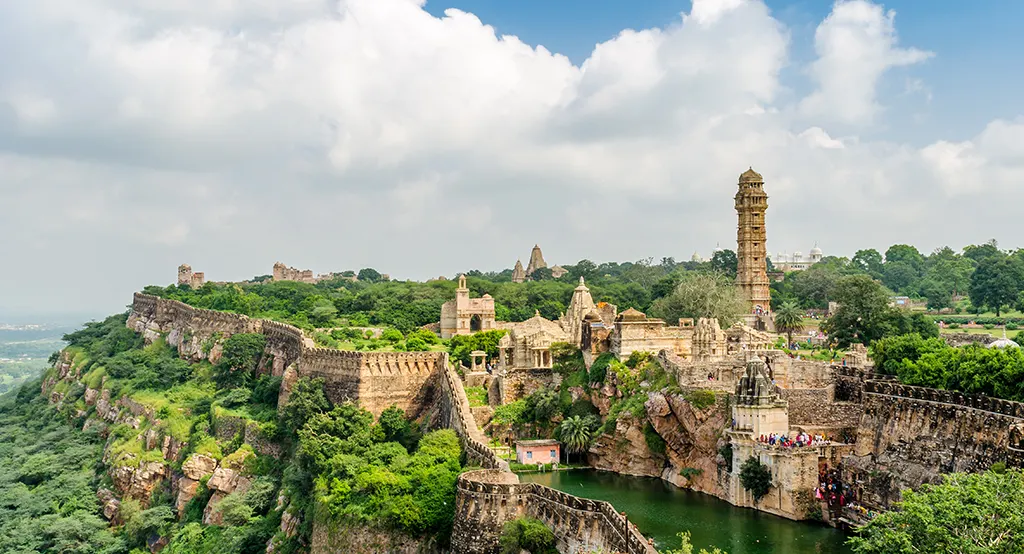
Chittorgarh Fort walls and towers on the hilltop · Photo via Wikimedia Commons
- Chittorgarh Fort sits on a 180 m hill about 115 km east of Udaipur, around 2 to 2.5 hours by road. It is part of the UNESCO World Heritage site Hill Forts of Rajasthan.
- Give it 3 to 4 hours. The fort is about 700 acres, so you drive between the monuments and walk at each one.
- Start at Kallaji Rathore’s shrine at Bhairon Pol on the way up, then loop past Rana Kumbha Palace, Vijay Stambh, Gaumukh Kund, Padmini Palace, Kirti Stambh and Ratan Singh Palace, and finish at Bayan Mata in the fort village.
- The fort is open every day. The Fateh Prakash Palace museum inside is closed on Mondays.
- From April to June, reach before the midday heat or go late in the afternoon. There is little shade on top.
01Chittorgarh Fort at a glance
| Where | Chittorgarh, Rajasthan, about 115 km from Udaipur on NH-27 |
|---|---|
| Size | About 700 acres on top of the hill, with a wall of roughly 13 km around it |
| Capital of | Mewar, until Maharana Udai Singh II founded Udaipur after 1568 |
| UNESCO | World Heritage Site since 2013, as one of the Hill Forts of Rajasthan |
| Famous for | Three sakas and jauhars, Rani Padmini, Meera Bai, Vijay Stambh, old Jain temples and the bravery of Jaimal, Kalla and Patta |
| Time needed | 3 to 4 hours inside; a full day from Udaipur |
02Chittorgarh Fort timings
The fort road is part of a living town, so you can drive up at any hour. The ticketed monuments, the museum and the show keep their own hours.
| What | Timing | Days |
|---|---|---|
| Ticketed monuments (Kumbha Palace, Vijay Stambh area and others) | About 9 AM to 6 PM | Every day |
| Fateh Prakash Palace museum | About 9:45 AM to 5:15 PM | Closed Mondays |
| Light and sound show at Kumbha Palace | After sunset, around 7 PM | Every day, subject to bookings |
| Kallaji Rathore shrine, Bhairon Pol | Morning to evening | Every day |
Timings checked September 2026. They can shift with the season and on holidays, so ask at the counter or message us before you go.
03Chittorgarh Fort ticket price
One Archaeological Survey of India (ASI) ticket covers the ticketed monuments inside the fort for that day. Keep it with you. It is checked at more than one place. Citizens of SAARC and BIMSTEC countries pay the same rate as Indian visitors. A service charge of about 10% is added to the ticket price.
| Ticket | Indian / SAARC / BIMSTEC | Foreign visitor |
|---|---|---|
| Fort monuments (ASI) | ₹35 + service charge | ₹550 + service charge |
| Children under 15 | Free | Free |
| Fateh Prakash Palace museum | ₹10–20 (child or student ₹5–10) | ₹50–100 (child ₹25–50) |
| Light and sound show | ₹170–190 (student ₹80–100) | ₹345–365 |
| Guide (approved, at Kumbha Palace) | Agree the fee before you start | |
Light and sound show tickets carry a small service charge of about 2.5% on top. Rates checked September 2026; they are revised from time to time.
Entry tickets are not part of our taxi fare. Your driver will show you where the counter is and wait while you buy them.
04The seven gates on the way up
- Padan Pol
- Bhairon Pol
- Hanuman Pol
- Ganesh Pol
- Jorla Pol
- Laxman Pol
- Ram Pol
The road from the town climbs the western face of the hill in zigzags and passes through seven gates, called pols. Each one was a line of defence. Your car drives through all of them, so there is no steep walk, but ask the driver to stop at Bhairon Pol, the second gate. That is where our visit always begins.
05Start at Veer Kallaji Rathore’s shrine
Most visitors drive straight past the lower gates to reach the palaces on top. I always stop here first, because the story told at Bhairon Pol explains everything you will see later on the hill.
In the winter of 1567, the Mughal emperor Akbar laid siege to Chittorgarh. Maharana Udai Singh II had moved into the hills to keep Mewar alive, and he left the fort in the hands of two commanders: Rao Jaimal Rathore of Merta and Patta Sisodia of Kelwa. For months they held out.
In February 1568, Jaimal was hit in the leg by a musket shot while he was repairing a broken section of the wall at night. Mughal chronicles say Akbar fired the shot himself. By morning the defenders knew the fort could not be held. The women performed jauhar, and the men put on saffron and opened the gates for a last battle: the third saka of Chittor.
Jaimal could not stand. His young nephew, Kalla Rathore, lifted him onto his shoulders, and the two rode into battle together, each with a sword in each hand. To everyone who saw them, it looked like a single warrior with four arms. That image is why Kallaji is remembered as the four-armed warrior. Local tradition goes further still and says Kalla kept fighting even after he was beheaded.
Both fell near Bhairon Pol. Two chhatris stand there today: Kalla’s with four pillars and Jaimal’s with six. Next to them is the shrine of Veer Kallaji Rathore, who is worshipped as a folk deity across Mewar and beyond. People from the villages still come here to pray and to make vows.
Patta Sisodia fell further up, near Ram Pol, where a memorial marks the spot. Akbar was so struck by the courage of Jaimal and Patta that he had stone statues of the two on elephants placed at a gate of the Agra Fort.
Spend 15 to 20 minutes here. Offer a prayer at the shrine if you wish, look at the chhatris, and then carry on up through Hanuman Pol to Ram Pol.
06What to see inside Chittorgarh Fort
This is the order our drivers follow after Ram Pol. The road runs south past the palaces and Vijay Stambh to Padmini Palace, comes back up the eastern side past Suraj Pol and Kirti Stambh, and returns through the fort village to Ram Pol. One loop, no going back and forth. The times are how long to spend at each stop, and the numbers match the map.
- 2. Rana Kumbha PalaceThe oldest palace on the fort and the heart of old Mewar. Maharana Udai Singh II, the founder of Udaipur, was born here, and this is where Panna Dhai is said to have saved him as a baby by giving up her own son. The light and sound show is held here in the evening.
- 3. Fateh Prakash Palace museumBuilt by Maharana Fateh Singh in the early 20th century, just across from Kumbha Palace. Weapons, sculpture from around the fort and paintings. Closed on Mondays.
- 4. Sattais Devri Jain templesClose to the museum, a group of Jain temples from around the 11th century dedicated to Adinath. The name means twenty-seven shrines; the main temple and a few smaller ones remain, with finely carved pillars and ceilings. Chittor was an important Jain centre, and Kirti Stambh later on the loop is Jain too.
- 5. Kumbha Shyam and Meera templesTwo temples in one courtyard, built in the time of Rana Kumbha. The smaller one is linked to Meera Bai, the poet-saint who was married into the Mewar family and spent her years here singing to Krishna.
- 6. Vijay Stambh (Tower of Victory)A nine-storey tower about 37 m tall, built by Rana Kumbha to mark his victory over Mahmud Khilji of Malwa in 1440. Every surface is carved with gods and goddesses. Climbing inside is currently not allowed.
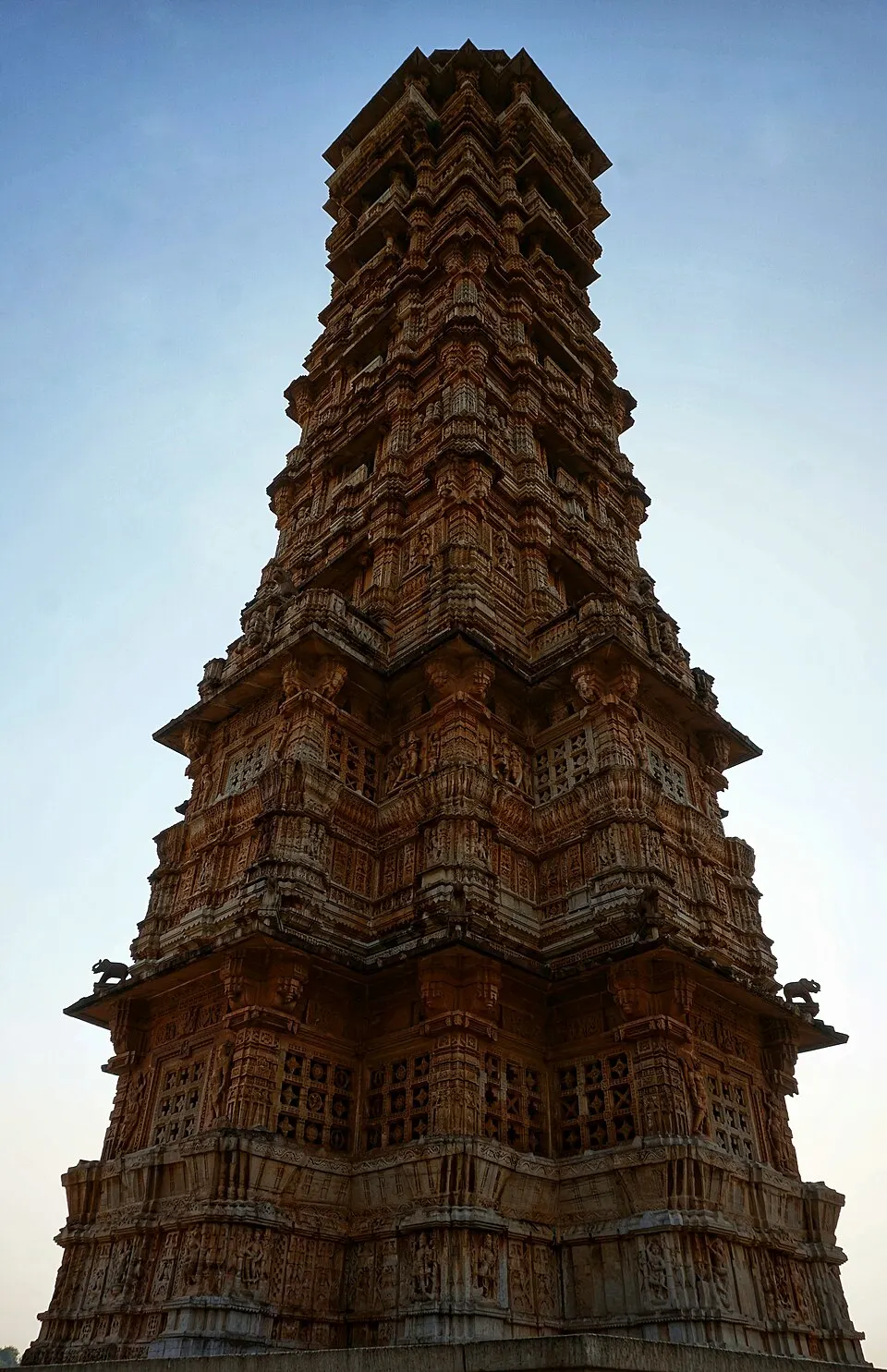
Vijay Stambh, the Tower of Victory, inside Chittorgarh Fort · Photo via Wikimedia Commons
- 7. Jauhar Sthal and Samadhishwar templeThe open ground next to Vijay Stambh is remembered as the place of jauhar. The Samadhishwar Shiva temple beside it has a large three-faced carving of Shiva.
- 8. Gaumukh KundSteps lead down the cliff to a deep tank fed by a spring that flows from a rock shaped like a cow’s mouth. It was the fort’s water supply during long sieges. The steps are steep, so take them slowly.
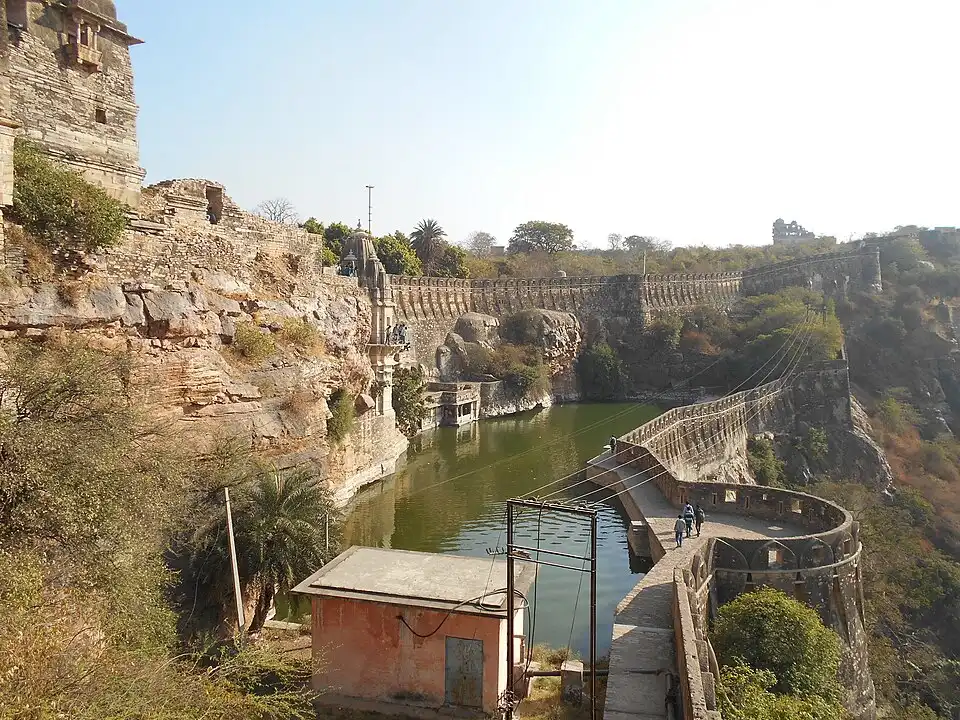
Gaumukh Kund water tank below the cliff at Chittorgarh Fort · Photo via Wikimedia Commons
- 9. Kalika Mata templeBuilt as a Sun temple around the 8th century and later dedicated to Goddess Kali. Look at the carved pillars and the old Surya figure on the doorway.
- 10. Rani Padmini PalaceA small white palace beside a pool, with a pavilion in the water. The story goes that Alauddin Khilji was allowed to see Rani Padmini only as a reflection, and that this is where it happened. Historians still debate the legend, but it is the story everyone knows.
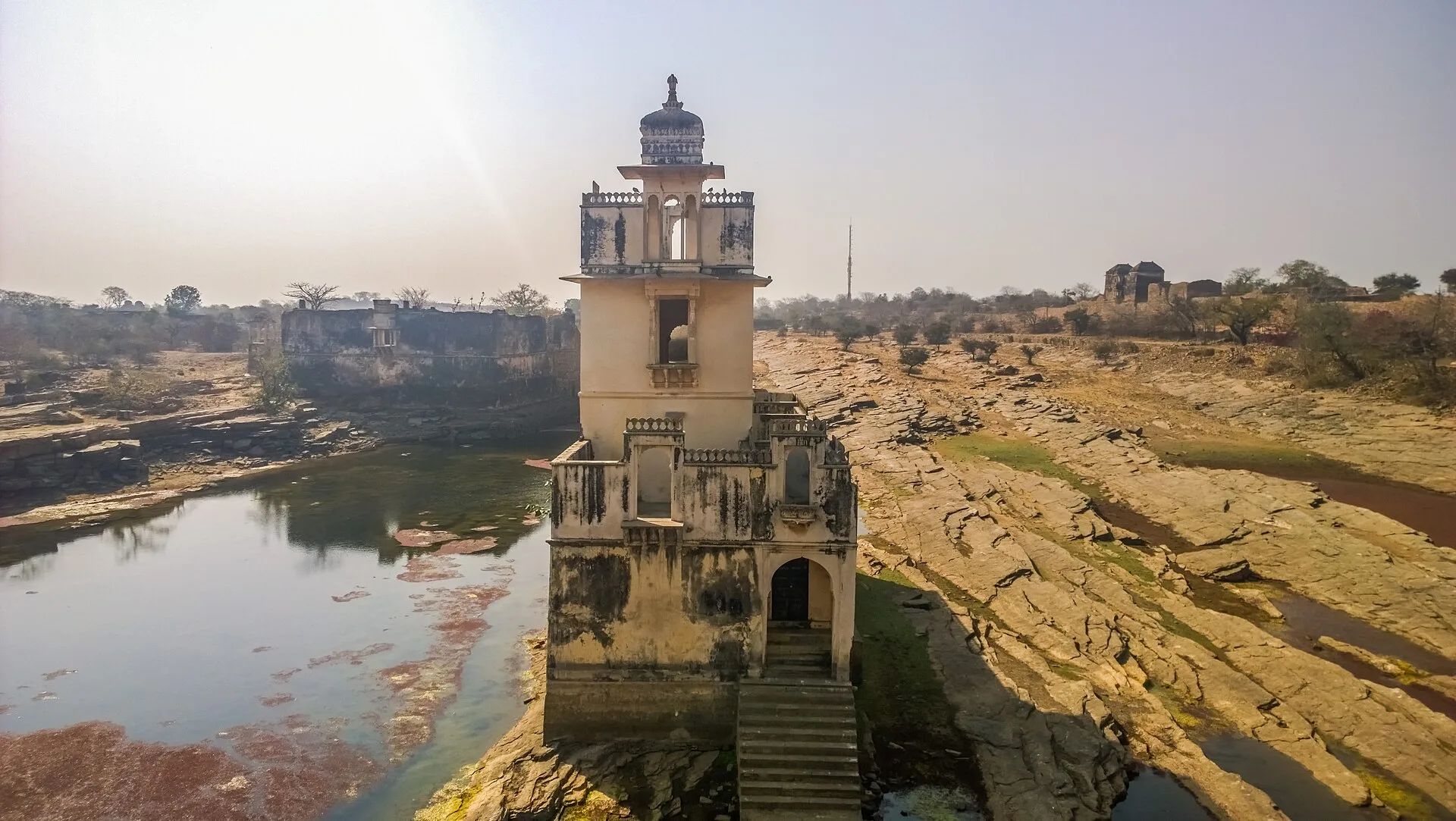
Rani Padmini Palace beside its pool at Chittorgarh Fort · Photo via Wikimedia Commons
- 11. Kirti Stambh (Tower of Fame)An older, smaller tower, about 22 m tall, built by a Jain merchant in the 12th century and dedicated to Adinath, the first Tirthankara. Quieter than Vijay Stambh and just as finely carved.
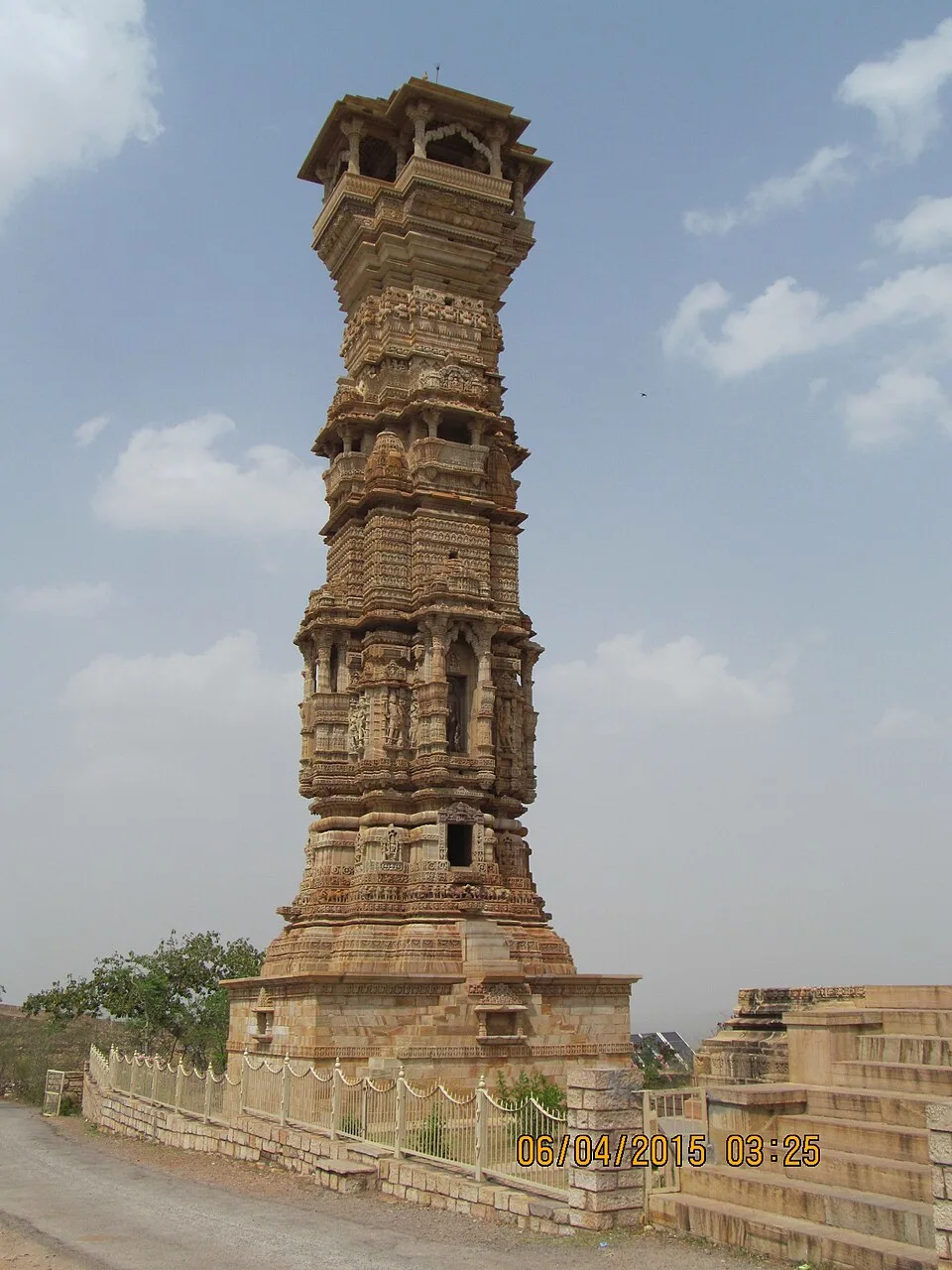
Kirti Stambh, the Jain Tower of Fame, at Chittorgarh Fort · Photo via Wikimedia Commons
- 12. Rana Ratan Singh PalaceOn the quiet northern side of the fort, beside the Ratneshwar lake. Fewer visitors come this far, so it is a calm place to sit for a few minutes and look over the water.
- 13. Bayan Mata (Ban Mata) templeIn the fort village, on the way back from Ratan Singh Palace. Bayan Mata is the kuldevi of the Guhil, later Sisodia, rulers of Mewar. Tradition says Bappa Rawal first installed her here. The temple was burnt in the Malwa attack of the 1440s and rebuilt with a new idol brought from Gujarat. Families of the old Mewar clans still come here in Navratri. From here the road takes you back to Ram Pol and down the hill.
With a little extra time, the fort also has the Tulja Bhavani temple, the deer park and Chitori Burj at the southern end, and viewpoints along the wall over the town and the Gambhiri river.
07Chittorgarh Fort history in short
Tradition says the fort was founded by Chitrangada Maurya in the 7th century, and that Bappa Rawal made it the seat of Mewar in the 8th century. For about 800 years it was Mewar’s capital. It fell three times, and each fall ended in a saka: the men rode out to fight to the last, and the women chose jauhar rather than capture.
| Year | Attacker | Remembered for |
|---|---|---|
| 1303 | Alauddin Khilji, Sultan of Delhi | Rawal Ratan Singh and Rani Padmini’s jauhar |
| 1535 | Bahadur Shah of Gujarat | Rani Karnavati’s jauhar |
| 1568 | Akbar | Jaimal, Kalla and Patta’s last stand |
After 1568, Maharana Udai Singh II built his new capital in the hills at Udaipur, and Mewar never returned to Chittor. So when you drive from Udaipur to Chittorgarh, you are going back to where the story of Udaipur began.
08Light and sound show
The show is held in the ruins of Rana Kumbha Palace after sunset. It tells the story of the fort, from Bappa Rawal to the three sakas, with lights on the old walls and a recorded narration.
- When: after sunset, around 7 PM. There is usually a Hindi show and an English show, one after the other.
- Length: about an hour.
- Tickets: about ₹170–190 for Indian adults, ₹80–100 for students and ₹345–365 for foreign visitors, plus a small service charge. Buy them at the counter near Kumbha Palace or online before the show.
- Off season: a show can be cancelled if too few people turn up. We confirm it for you on the day.
Staying for the show means you reach Udaipur late at night, about three hours later than a normal day trip. That is why it is an add-on on our Chittorgarh taxi round trip, not part of the standard plan.
09One-day plan from Udaipur
Chittorgarh works well as a day trip. This is how we plan it. The exact times depend on when you leave, and our booking box works them out for you.
- Leave Udaipur after breakfastEast on NH-27, a smooth four-lane highway. About 2 to 2.5 hours.
- Sanwariya Seth, MandphiyaA short detour for darshan on the way. The temple closes around midday, so it only works on an early start.
- Bhairon Pol and KallajiStop on the way up. Then drive on through Ram Pol.
- Inside the fortFollow the loop above. Break for lunch in town before or after, as you like.
- Back to UdaipurYou reach your hotel in the evening. With the light and sound show, you are back late at night.
Moving on from Udaipur rather than coming back? We also do a one-way drop to your Chittorgarh hotel or the railway station.
10How to reach Chittorgarh Fort from Udaipur
| Option | Time | Good for |
|---|---|---|
| Taxi day trip | 2–2.5 hrs each way | Families and groups; the car takes you between monuments inside the fort |
| Bike on rent | 2.5 hrs each way | Experienced riders; ride in daylight and watch for trucks |
| Train or bus | 2–3 hrs | Solo travellers; you will need an auto to go up and around the fort |
A same-day taxi round trip starts at ₹3,500 in a sedan, including fuel and driver. Highway tolls and entry tickets are extra. You can build your trip, add Sanwariya Seth or the light and sound show, and see the full day plan on our Udaipur to Chittorgarh taxi page.
11Before you go
- Wear good shoes. You walk on old stone, and the steps to Gaumukh Kund are steep and uneven.
- Carry water and a cap. There is very little shade on top, even in winter.
- Dress for temples. Shoulders and knees covered, and shoes off at Kallaji, Meera and Kalika Mata temples.
- Mind the langurs. Keep food in the car and don’t feed them.
- Avoid Monday if the museum matters to you.
- Hire a guide if you want the full story. Approved guides wait near Kumbha Palace. Fix the fee first.

Written by Rajkumar Singh, co-founder of Udaipur Ride. He has spent more than 20 years exploring Udaipur and every corner of Rajasthan, and checks the timings and fares in our guides with our drivers. Timings and fees were last checked in September 2026. Spotted something out of date? Tell us on WhatsApp.
Chittorgarh Fort: FAQs
Short answers to what our guests ask before the trip.
Still have a question?
Message us on WhatsApp. A real person from our Udaipur team will reply.
Ask on WhatsApp
What are Chittorgarh Fort timings?
The ticketed monuments are open every day, roughly 9 AM to 6 PM. The Fateh Prakash Palace museum is closed on Mondays, and the light and sound show starts after sunset.
What is the Chittorgarh Fort ticket price?
The ASI ticket is ₹35 for Indian, SAARC and BIMSTEC visitors and ₹550 for other foreign visitors, plus a service charge of about 10%. Children under 15 go free. The museum is about ₹10–20 and the light and sound show about ₹170–190 for Indian adults, bought separately.
How much time do I need for Chittorgarh Fort?
Three to four hours inside, with a car to move between monuments. From Udaipur it is a full day, including about 2 to 2.5 hours of driving each way.
Who was Kallaji Rathore?
Kalla Rathore was the nephew of Rao Jaimal. In the 1568 siege he carried the wounded Jaimal on his shoulders into battle, both fighting with two swords, so they looked like one four-armed warrior. They fell near Bhairon Pol, where their chhatris and Kallaji’s shrine stand today. He is worshipped as a folk deity across Mewar.
What is Chittorgarh Fort famous for?
Its size, its three sakas and jauhars, the stories of Rani Padmini, Meera Bai and Jaimal and Kalla, and the carved Vijay Stambh and Kirti Stambh towers.
Can I climb the Vijay Stambh?
Not at present. Visitors can see the tower up close and walk around it, but the stairs inside are closed.
Can I see Chittorgarh Fort as a day trip from Udaipur?
Yes. Leave after breakfast and you are back by evening. Our Udaipur to Chittorgarh taxi starts at ₹3,500 in a sedan, with Sanwariya Seth and the light and sound show as add-ons.
What is the best time to visit Chittorgarh Fort?
October to March, when days are pleasant. The monsoon turns the hill green but the stone paths get slippery. From April to June, avoid the midday hours on top.